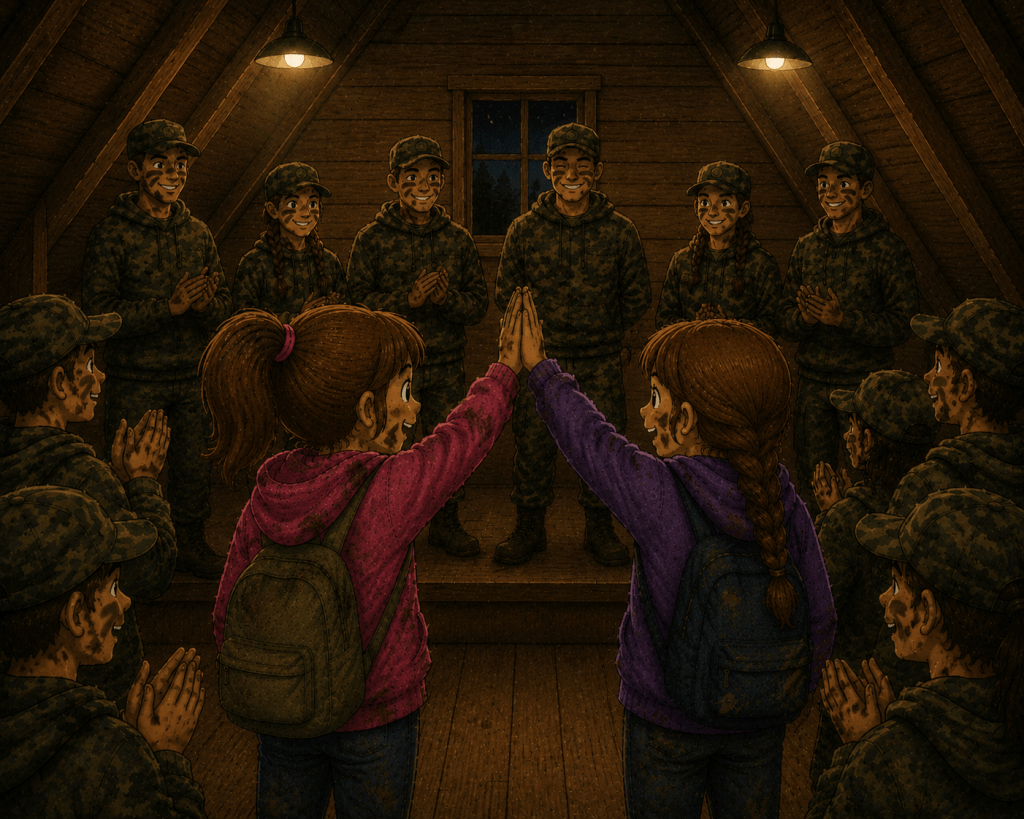
When I was fifteen years old, I went on a summer mission trip to Venezuela through Brio, a Christian magazine for teenage girls.

That sentence alone should tell you that we are entering a very specific historical ecosystem.
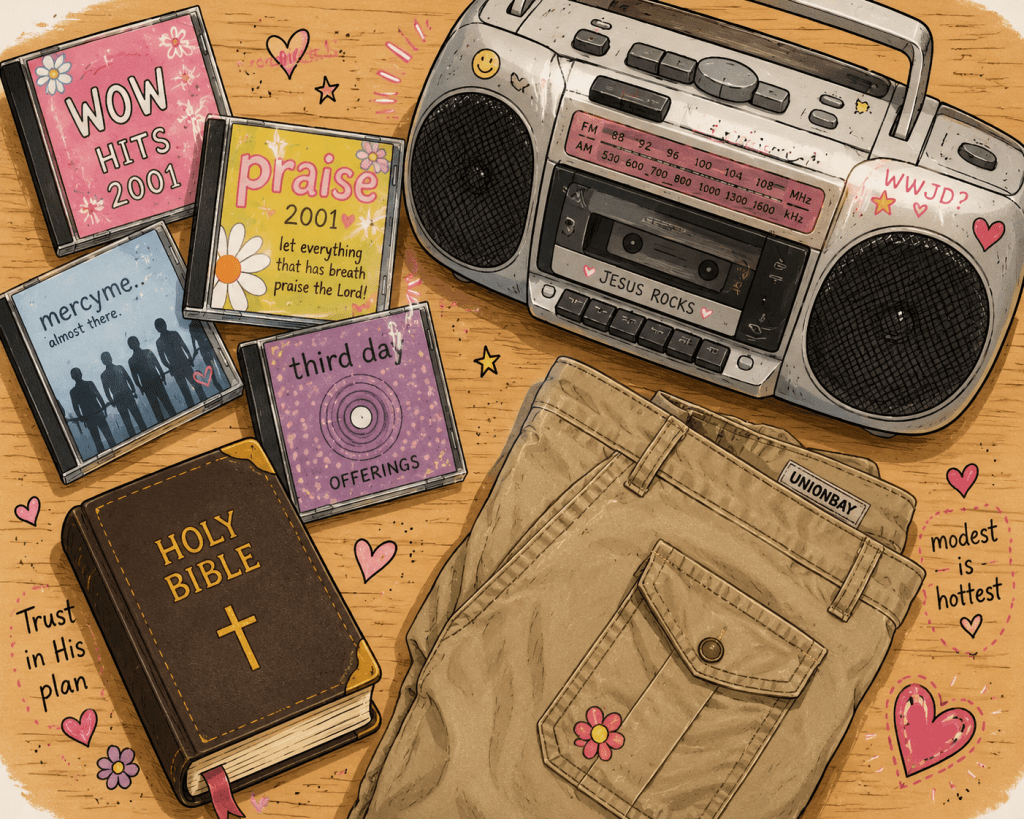
It was the early 2000s. Christian youth culture was thriving. WWJD bracelets were roaming freely across the land. Cargo pants had not yet been brought to justice. And somewhere in Caracas, Venezuela, a fifteen-year-old Quaker girl was about to discover that apparently Jesus could be communicated through mime.
I was the mime.

For a couple of weeks, our team performed street ministry in Caracas. We acted out a metaphorical story about Jesus, which meant I spent my days wearing entirely black clothing and thick white face paint.
In Venezuela.
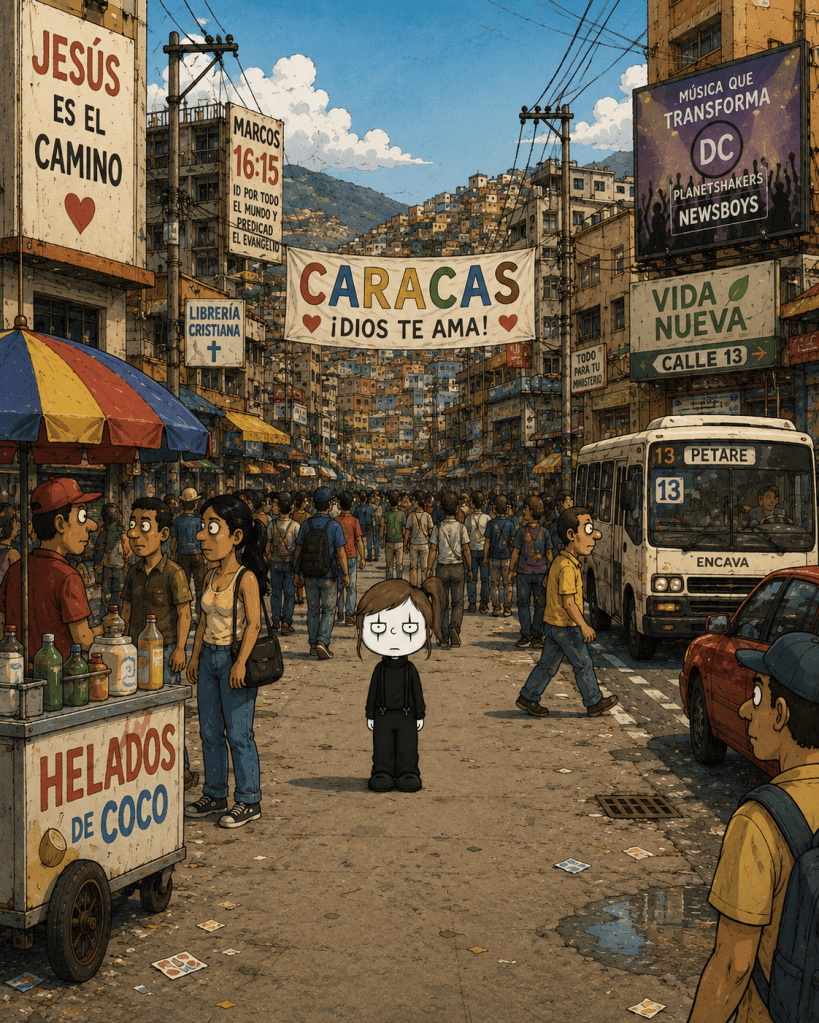
In the summer.

Under the open sun on hot pavement.

For literally weeks.

Nothing says abundant life quite like slowly baking inside a black turtleneck while pretending to be trapped behind an invisible wall.

But I loved it… kind of.
The whole experience felt enormous and important and slightly surreal.
There was also a very popular Christian Pop girl group on the trip.

I will not be naming them, primarily because I have no desire to accidentally summon an attorney from the year 2001.
But they were famous.
Like. Actually famous. In real life.
At least, they were Christian teenager famous, which at the time felt approximately equivalent to Britney Spears.
So, every evening after dinner, all the teams would gather and the band would perform for us.
Through a peculiar series of circumstances, I had been placed on a ministry team with the daughter of one of the magazine’s producers. That meant our little group ended up spending quite a bit of time with the band.

And one of the members took a liking to me.

She was incredibly kind.
She asked questions about my life. She listened to me talk about my family and my faith and the complicated little spiritual universe rattling around inside my fifteen-year-old brain.

I was heavily questioning the validity of Jesus, and she seemed genuinely interested in that struggle.
Then, one particularly dramatic evening, she prayed for me in tongues in the back alley behind our hotel.
Don’t ask me how we ended up in the alley. It just happened.

So there I was, somewhere behind a hotel in Caracas, while Christian Britney Spears prayed over me in a language I could not identify.
And honestly?
It was both terrifying and kind of beautiful.
Because, fun fact, Quakers don’t pray in tongues. They barely clap.
When the trip ended, she surprised me.
“I don’t normally do this,” she said, “but here’s my email address. Keep in touch. And when we come through your city, you can come to one of our concerts!”

I floated back to Idaho.
I had a famous Christian friend!

This was tremendous news for fifteen-year-old me.
Because I was not exactly sitting at the summit of the adolescent social hierarchy in North Idaho.
I was awkward.
I wore a lot of shlumpy clothes.

I had the general social energy of someone who might silently stare at you when asked what she did over the weekend.

But now?
Now I knew someone in a famous band.
Naturally, I kept in touch.
Eventually I saw that the group was coming to Spokane.
So, of course, I emailed her.

She seemed genuinely excited.
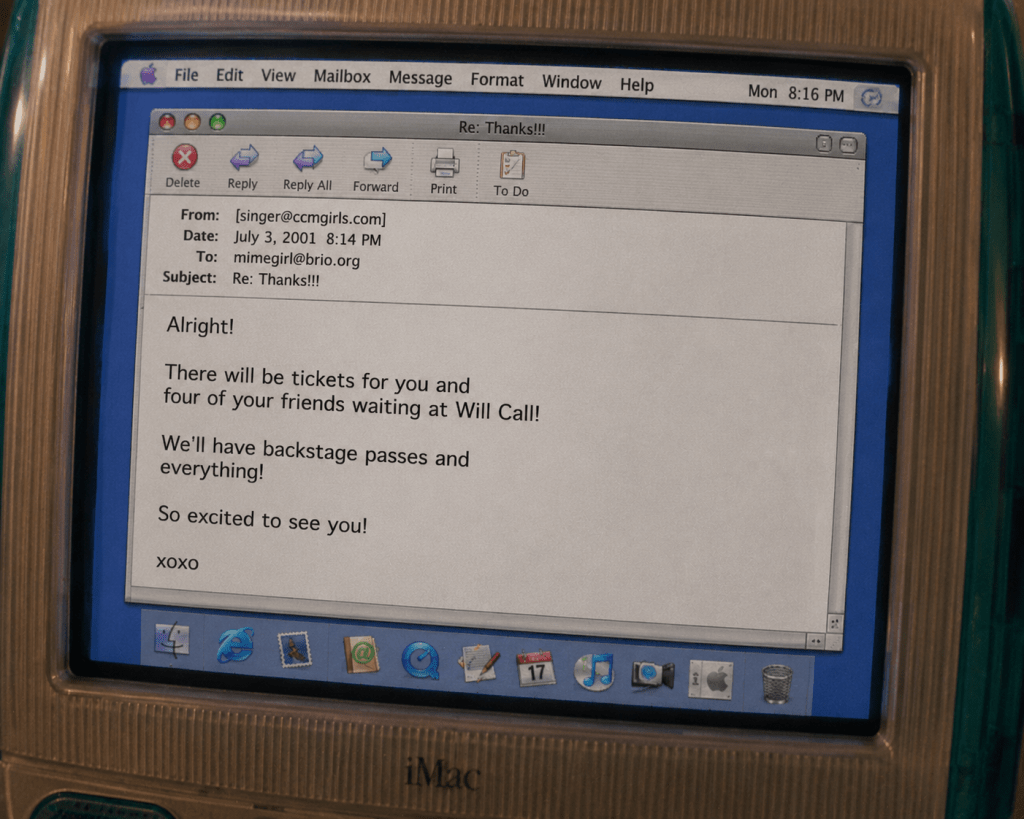
Backstage passes!
Friends, this was my moment.

I invited several girls from youth group.
And because I was fifteen and still desperately trying to understand the brutal economics of teenage belonging, I invited some girls from the popular crowd.
Perhaps this would be the evening when everyone discovered that awkward Kristin was secretly very cool?
Spoiler:
It was not.

We drove to Spokane.
We arrived at the event venue.

The place was packed.
We walked confidently up to Will Call.
I gave them my name.
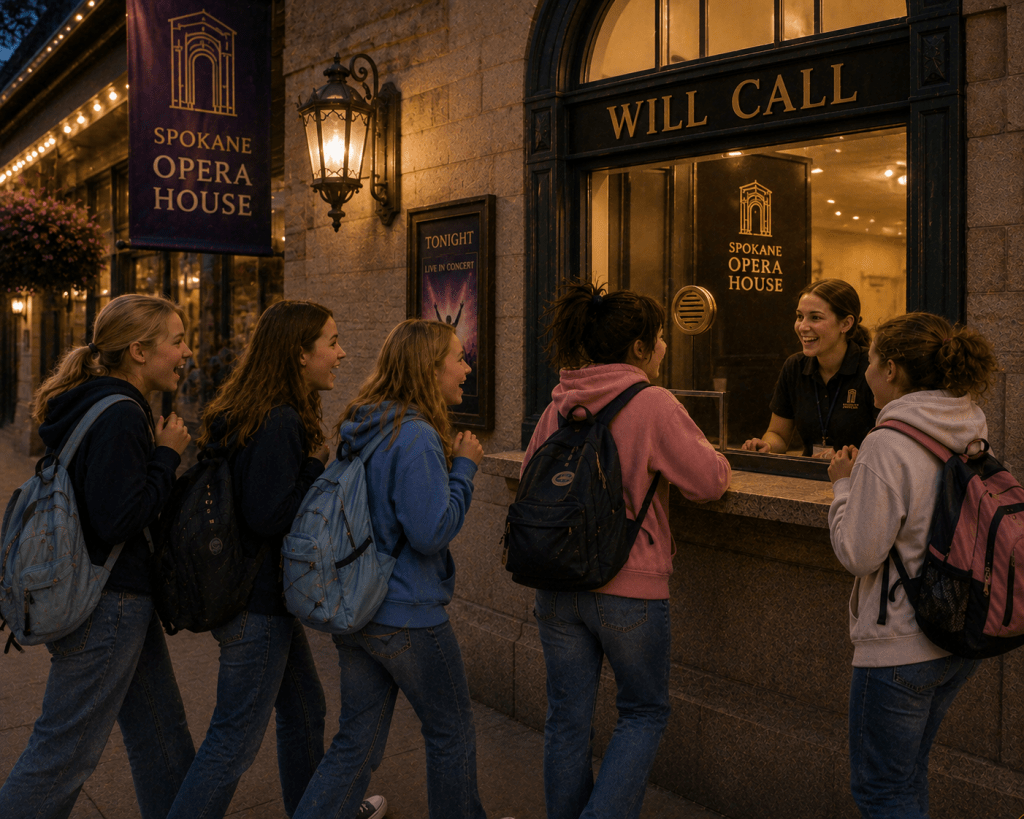
They looked.
Nothing.
They looked again.
Still nothing.

I explained that we were guests of the band.
More looking.
No tickets.
No backstage passes.
No mysterious envelope bearing my name.
Nothing.
And this was before cell phones.
So there was no quick text.
No “hey girl lol we’re downstairs.”
No frantic Instagram DM.
My famous Christian friend might as well have been communicating from the moon.
I can still remember the feeling spreading through my body as I stood there with those girls from youth group watching me.
Cold panic.
Then embarrassment.
Then that terrible adolescent realization:
Oh no. Nobody believes me.

The people working at Will Call eventually felt so badly for me that they let us into the concert anyway.
Which was genuinely kind.
But by then, the evening had acquired the unmistakable aroma of social death.

We watched the concert.
No backstage passes.
No special meeting.
No triumphant moment where I casually waved toward the stage and said, “Oh, her? Yeah, we’re friends.”
Just five teenage girls sitting together while I quietly attempted to evaporate.

I never really recovered socially from it in youth group.
Later, I emailed my friend from the band.
She apologized.
She had mixed up the cities.
She had sent our tickets and backstage passes to Seattle.
I thanked her.
And that was pretty much the end of our relationship.
For years, though, what stayed with me wasn’t the absurdity.
It was the hurt.
And somewhere inside my young spiritual imagination, I connected that hurt to Jesus.
I had already been struggling.
I had gone to Venezuela trying to serve him. I had sweated through mime ministry for him. I had sat in a back alley while somebody prayed in tongues over my little Quaker soul.
And then I came home and experienced public humiliation in front of the cool kids.
So somewhere inside me was this question:
He knew how fragile I was.
He knew how badly I wanted to belong.
He knew exactly how much this would hurt.
And He let it happen anyway?
What a jerk.
I don’t see it that way anymore.
In fact, I think it’s very cool and very special that I got to meet my famous friend at all.
I think one of the hardest things about faith is learning to distinguish Jesus from all the people and institutions operating under His name.
Because humans are incredibly fallible.
Even kind humans.
Even sincere humans.
Even Christian humans.
Maybe especially Christian humans.
People forget things.
People overpromise.
People get cities mixed up, especially when they’re busy.
People underestimate the emotional weight their words carry.
Organizations create experiences they aren’t always equipped to shepherd people through.
Churches make mistakes.
Ministries make mistakes.
Leaders make mistakes.
Sometimes those mistakes are relatively ordinary.
Sometimes they are catastrophic.
And sometimes what gets called “church hurt” isn’t an innocent administrative mistake at all. Sometimes it involves manipulation, abuse, coercion, exploitation, spiritual intimidation, or profound betrayal.
Those things should not be flattened into one category.
My backstage-pass disaster was painful. It left a mark. But it wasn’t insidious.
No human was actively trying to hurt me.
Sometimes I think we hand Jesus the bill for every mistake another human does while wearing His name tag.
I understand why.
When someone tells you, “This is what God wants,” and then harms you, separating that person from God can become extraordinarily difficult.
When a religious institution fails you, it can feel like heaven failed you.
When Christians embarrass you, reject you, manipulate you, abandon you, or simply promise something they cannot deliver, Jesus can become tangled up inside the injury.
Untangling him can take years.
Apparently, in my case, approximately twenty-five.
But these days, when I look back at that fifteen-year-old girl standing at Will Call, I don’t imagine Jesus somewhere backstage shrugging.
I imagine Him much closer to her.
I imagine Him knowing exactly how embarrassed she was.
Knowing that she would carry that ridiculous little evening much longer than anyone else involved ever realized.
Knowing that someday she would finally be able to look at it without needing a villain.
Without blaming her friend.
Without blaming herself.
Without blaming the church.
And without blaming Jesus Himself.
That seems like a surprisingly important spiritual lesson.
Because grace doesn’t require us to pretend nothing happened.
Forgiveness doesn’t require us to call harmful things harmless.
And recognizing human fallibility doesn’t mean excusing every failure of religious leadership or institutions.
It simply means we can become more precise about where responsibility belongs.
Sometimes there is genuine wrongdoing that deserves accountability.
Sometimes there is carelessness that needs repair.
And sometimes your backstage passes are sitting in Seattle.